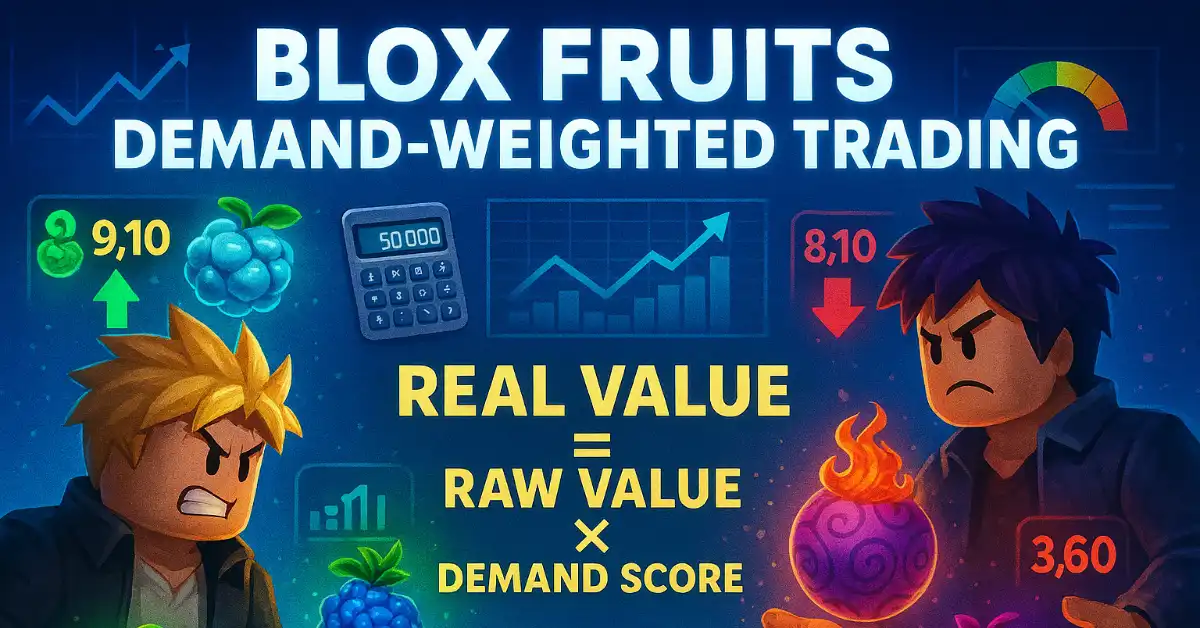
Here’s something most Blox Fruits traders get wrong: two fruits with the same value are not automatically a fair trade. Not even close.
That’s the core idea behind demand-weighted trading a method that adjusts a fruit’s effective value based on how much the community actually wants it right now. By the end of this guide, you’ll know exactly how demand-weighted math works, how to calculate real fruit value yourself, and why skipping this step is leaving trades on the table.
The Problem With Raw Value Alone
Every Blox Fruits value list assigns a number to each fruit. These numbers represent how the community prices an item based on rarity and trading history. The problem is that raw value doesn’t tell you whether people actually want that fruit today. A fruit worth 15,000 on paper but sitting at a demand rating of 2 out of 10 is basically dead weight. Nobody’s trading for it. You’d have to accept far less just to move it.
What Is Demand-Weighted Trading in Blox Fruits?
Demand-weighted trading means factoring in how wanted an item is — not just what it’s listed at. The method adjusts a fruit’s effective value up or down based on its demand score before you compare both sides of a trade. High-demand fruits trade at or above their listed value. Low-demand fruits trade below it. This creates what traders call real value — what an item is actually worth in a live trade, right now, not in theory.
How Demand Ratings Work
Demand ratings are community-generated scores on a scale of 1 to 10. They reflect how actively traders are seeking a specific fruit in trading servers, Discord communities, and in-game trading hubs.
- Current meta: Is this fruit considered overpowered in PvP or raids right now?
- Recent updates: Did a patch buff or nerf this fruit?
- Availability: Is it obtainable from the Gacha, or does it only drop rarely?
- Community hype: Are popular content creators using it?
- Seasonal events: Is it limited-time or always available?
Always cross-check demand scores from two or three sources before making a big trade decision. Demand ratings are opinions, not hard data different communities may rate the same fruit differently.
The Demand-Weighted Math: How to Calculate Real Fruit Value
The Basic Formula
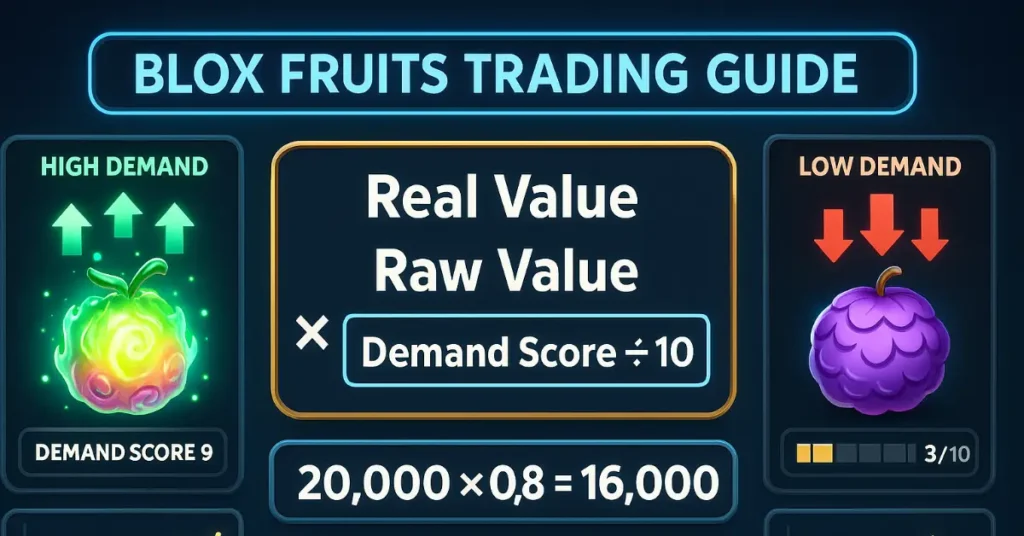
Real Value = Raw Value multiplied by (Demand Score divided by 10)
A fruit with a raw value of 20,000 and a demand score of 8 out of 10 has a real value of 20,000 x 0.8 = 16,000.
A fruit with a raw value of 15,000 and a demand score of 10 out of 10 has a real value of 15,000 x 1.0 = 15,000.
Comparing Both Sides of a Trade
- List every item you’re giving — find raw value and demand score for each
- Apply the formula: Real Value = Raw Value x (Demand divided by 10)
- Add up your side’s total real value
- Repeat for the other side
- Compare totals: within 10% = Fair, you get more = Win, you give more = Loss
Here’s what demand-weighted math does to common fruits:
- Kitsune: Raw 12,000 x demand 0.9 = Real Value 10,800
- Dragon: Raw 10,000 x demand 0.7 = Real Value 7,000
- Leopard: Raw 8,000 x demand 0.8 = Real Value 6,400
- Venom: Raw 6,000 x demand 0.5 = Real Value 3,000
- Rumble (Perm): Raw 5,000 x demand 0.3 = Real Value 1,500
Notice how Rumble (Perm) drops from 5,000 raw value to just 1,500 in real value because of low demand. That’s demand-weighted math doing its job.
Side-by-Side Trade Examples
Example 1 — The Equal-Value Trap
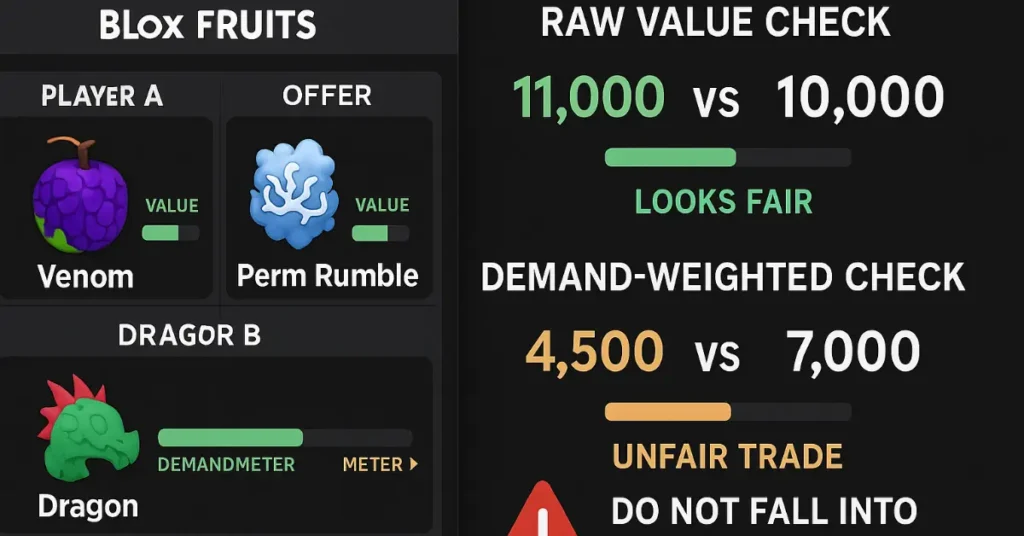
Player A offers: Venom (raw 6,000 / demand 5) + Rumble Perm (raw 5,000 / demand 3). Player B offers: Dragon (raw 10,000 / demand 7). Raw value check: 11,000 vs 10,000 — looks almost fair. Demand-weighted check: Player A’s side = 3,000 + 1,500 = 4,500. Player B’s side = 7,000. Player A is giving real value of 4,500 for real value of 7,000. Raw value made this trade look fair. Demand-weighted math exposed it.
Example 2 — The Underrated Fair Trade
Player A offers: Leopard (raw 8,000 / demand 8). Player B offers: Kitsune (raw 12,000 / demand 9) but asks for an add. Leopard real value = 6,400. Kitsune real value = 10,800. A straight swap would be a loss for Player A. But if Player B’s add is a fruit worth around 4,000+ real value, the trade balances out. This is how demand-weighted thinking helps you negotiate adds accurately instead of guessing.
Limitations of Demand-Weighted Math
- Demand scores lag behind the meta a fruit buffed in yesterday’s patch may still show a low score today
- Different communities rate demand differently cross-check always
- Demand doesn’t account for personal urgency if you need a specific fruit tonight, a slight loss might be worth it
- Very rare fruits may have volatile demand that changes within hours during hype cycles
- The formula is a guide, not a law use it as your foundation, then layer community knowledge on top
Frequently Asked Questions
What does demand mean in Blox Fruits trading?
Demand measures how actively traders are looking for a specific fruit right now. It’s rated on a scale of 1–10. A score of 9–10 means everyone wants it and trades happen fast at full value. A score of 2–3 means few players want it, so you’ll likely trade it below its listed value.
Why do two fruits with the same value trade differently?
Because demand is different. A fruit worth 10,000 with demand 9 trades easily at or near full value. A fruit worth 10,000 with demand 3 is much harder to move you often have to accept 50–60% of its listed value just to close the deal. Same number on paper, very different in practice.
How do I calculate demand-weighted value in Blox Fruits?
Use this formula: Real Value = Raw Value multiplied by (Demand Score divided by 10). For example, a fruit with raw value 8,000 and demand score 7 has a real value of 5,600. Add up both sides of a trade using this method, then compare the totals.
Is a high-demand fruit always better to trade with?
Not always, but high-demand fruits trade faster and closer to full value. If you’re building a trading stack, high-demand fruits are better currency. Low-demand fruits may have high listed value but trade slower and at a discount.